
Choosing an Early Learning Centre: What Quality Really Looks Like
Every parent who tours a centre asks the same question beneath all the others: Will my child be happy, safe, and well cared for here?
It is a big decision. Most centres will tell you they are nurturing, play-based and passionate about children. The challenge is working out which ones actually are. This guide explains what separates a good centre from a great one, which questions reveal the most, and how we approach each area at Brady Bunch Early Learning Centre.
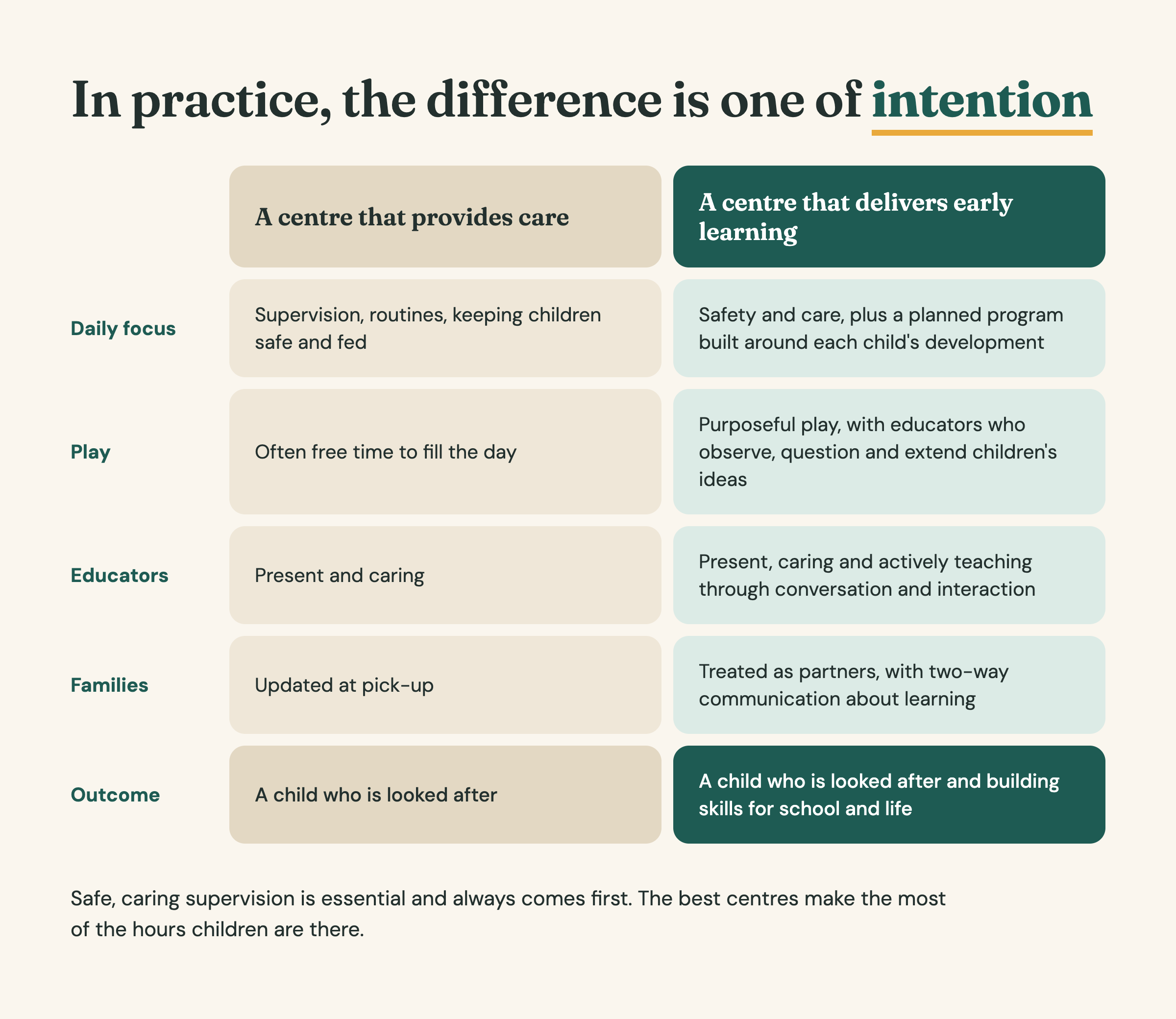
Is there a difference between childcare and early learning?
You will hear both terms, and they are often used interchangeably. In Australia, the National Quality Framework regulates all approved long day care services and sets minimum standards for safety, staffing, and educational programs. So the useful question is not "childcare or early learning?" but "how much does this centre go beyond the basics?"
Why the early years matter so much
The first five years are a period of extraordinary brain development. According to Harvard's Center on the Developing Child, more than a million new neural connections form every second in the early years. Experience shapes those connections, especially warm, responsive relationships and rich, playful interactions.
Research on early childhood education consistently links high-quality programs with stronger language, social and learning outcomes. The key word is quality. Hours in care matter less than what happens during them.
What quality early learning looks like: six things to check
1. Warm, stable relationships
Young children learn best when they feel secure. Look for educators who get down to a child's level, respond warmly and know each child by name, including their likes, dislikes and what comforts them.
Ask how long educators have been at the centre. High staff turnover can make it hard for children to form secure attachments. Our centre directors and educators are committed to building long-lasting relationships with you and your family.
2. Qualified educators and a thoughtful program
Australian services must meet national requirements for educator qualifications, and larger services must employ or have access to an early childhood teacher. Ask about the team's qualifications, how they keep learning through professional development, and how they plan the program.
A good program is built on the Early Years Learning Framework and responds to children's interests rather than relying on pre-made craft activities.
3. Play with purpose
Play is how young children learn, but not all play is equal. Look for open-ended materials such as blocks, fabric, boxes, and natural items, and give them time to become deeply absorbed in an activity. A great story can fuel a whole afternoon of imaginative play, building language, empathy and problem-solving along the way. (We explain how in our article on [how stories inspire play, link].)
4. Emotional learning woven into the day
Big feelings are a normal part of early childhood. What matters is how adults respond. In a high-quality centre, educators stay calm, acknowledge feelings before guiding behaviour and help children find words for what they feel. Our guide to [big feelings in toddlers and preschoolers, link] explains what to expect at each age.
5. Nourishing food and relaxed mealtimes
In long day care, children eat most of their weekday meals at the centre. That makes food quality part of early learning, not an afterthought. Ask whether meals are cooked on-site, whether you can see the menu, and how they manage allergies. See [Fuelling Little Learners: The Difference Fresh Food Makes, link] for more detail on what to look for.
6. A genuine pathway to school
Good early learning builds the skills that matter in the first year of school: managing feelings, listening, friendship, communication, independence, resilience and curiosity. We call these our [seven pillars of school readiness, link]. Ask any centre how they prepare children for the transition, and how they share information with schools.

Safety: what to check on your tour
Safety underpins everything else, and it should show in the details. Look for:
Secure entry and exit, with clear sign-in and sign-out procedures
Active supervision, with educators positioned so they can see and hear children, indoors and outdoors
Educator-to-child ratios that meet or exceed legal requirements. These are set by law and vary by age, so ask how the centre staffs its rooms and what happens when an educator is absent
First aid, CPR and anaphylaxis training, with current certificates
Working with children checks, such as a Blue Card in Queensland, for all staff
Clear policies for allergies, medical conditions, sun safety, hygiene and incident reporting
Safe, well-maintained indoor and outdoor spaces
Emotional safety matters just as much. Children who feel secure and respected take risks, try new things and learn more freely.
Understanding the National Quality Standard rating
Every approved service in Australia is assessed against the National Quality Standard and receives a rating, such as Meeting NQS or Exceeding NQS. You can look up any centre's rating on the Starting Blocks website (startingblocks.gov.au).
A rating is a useful starting point, but it is not the whole story. Combine it with what you see and feel on a tour.
Starting care: helping your child (and you) settle
Separation anxiety is a normal part of early childhood, and it affects parents too. A good centre will not rush the process. Look for:
Gradual orientation visits, so your child can get to know the space and the people
Comfort items from home, such as a soft toy or blanket, welcomed without fuss
Predictable goodbye routines that are short, warm and consistent
Calm, consistent educators who can reassure your child after you leave
Honest communication, including a message or photo to let you know how they settled
Many children cry at drop-off and are happily playing within minutes. A caring centre will let you know when that happens. [Describe Brady Bunch's settling-in process, such as orientation visits, a key educator for each child and how you update families.]

Why families choose Brady Bunch
[Placeholder.]
A genuine family feel. [Describe how educators get to know each family, your community events and your approach to partnership.]
Fresh, chef-prepared meals. [Confirm your kitchen set-up and what is cooked onsite.]
A program built around the whole child. Play-based learning that supports emotional wellbeing, communication, independence and curiosity, with a clear pathway to school. [Add program details, e.g. kindergarten program.]
Educators who stay. [Add retention information, qualifications and ongoing training.]
Open communication. [Add how families receive updates, such as a family app, daily reports or learning stories.]
A safe, welcoming environment. [Add specific features of your centre, rooms and outdoor spaces.]
[Add a short, genuine family testimonial or a real example of a child's journey here. It is the single most persuasive element of this section.]
Questions to ask on your tour
Bring this checklist to any centre, including ours.
How long have your educators been here, and what are their qualifications?
How do you plan the program, and how do you follow children's interests?
What does a typical day look like?
How do you support children through big emotions?
Are meals cooked on-site, and can I see the menu?
How do you manage allergies and medical conditions?
What are your ratios, and how do you manage staff absences?
How will I hear about my child's day and learning?
How do you help children and families settle in?
How do you prepare children for school?
Pay attention to how they answer. Confident, specific responses with real examples are a good sign. Vague or rehearsed answers are worth probing further.
Trust your instincts on the day
Beyond the checklist, notice the atmosphere. Do the children look happy and engaged? Do educators speak to them warmly and at their level? Does the centre feel calm, and does it feel like a place your child could belong? Many parents say they knew a centre was right within minutes of walking in. A tour lets you see that for yourself.
Come and see for yourself
The best way to choose a centre is to walk through the door, meet the educators and watch children at play. We would love to show you around. Book a tour of one of our many Brady Bunch Early Learning Centres, meet our team and see whether it feels like the right place for your child.